 An official website of the United States government


Statistics at a Glance
At a Glance
Estimated New Cases in 2026 11,270
% of All New Cancer Cases 0.5%
Estimated Deaths in 2026 1,700
% of All Cancer Deaths 0.3%
5-Year
Relative Survival
| Year | Rate of New Cases — SEER 8 | Rate of New Cases — SEER 12 | Death Rate — U.S. | 5-Year Relative Survival — SEER 8 | ||||
|---|---|---|---|---|---|---|---|---|
| Observed | Modeled Trend | Observed | Modeled Trend | Observed | Modeled Trend | Observed | Modeled Trend | |
| 1975 | 0.82 | 0.78 | - | - | 0.04 | 0.03 | 63.28% | 56.87% |
| 1976 | 0.87 | 0.79 | - | - | 0.04 | 0.04 | 57.46% | 57.31% |
| 1977 | 0.76 | 0.81 | - | - | 0.03 | 0.05 | 51.71% | 57.74% |
| 1978 | 0.79 | 0.83 | - | - | 0.03 | 0.07 | 54.93% | 58.18% |
| 1979 | 0.98 | 0.85 | - | - | 0.12 | 0.10 | 52.25% | 58.61% |
| 1980 | 0.90 | 0.87 | - | - | 0.13 | 0.14 | 57.88% | 59.03% |
| 1981 | 0.90 | 0.89 | - | - | 0.13 | 0.14 | 48.64% | 59.46% |
| 1982 | 0.86 | 0.91 | - | - | 0.15 | 0.14 | 54.62% | 59.88% |
| 1983 | 0.98 | 0.94 | - | - | 0.14 | 0.14 | 67.34% | 60.30% |
| 1984 | 1.05 | 0.96 | - | - | 0.16 | 0.14 | 61.91% | 60.72% |
| 1985 | 1.11 | 0.98 | - | - | 0.15 | 0.15 | 61.22% | 61.13% |
| 1986 | 0.76 | 1.00 | - | - | 0.15 | 0.15 | 70.15% | 61.54% |
| 1987 | 0.97 | 1.03 | - | - | 0.15 | 0.15 | 61.99% | 61.95% |
| 1988 | 1.03 | 1.05 | - | - | 0.15 | 0.15 | 55.78% | 62.35% |
| 1989 | 1.02 | 1.08 | - | - | 0.15 | 0.15 | 65.85% | 62.76% |
| 1990 | 1.17 | 1.10 | - | - | 0.16 | 0.16 | 57.91% | 63.15% |
| 1991 | 1.10 | 1.13 | - | - | 0.18 | 0.16 | 60.30% | 63.55% |
| 1992 | 1.11 | 1.16 | 1.19 | 1.16 | 0.16 | 0.16 | 58.32% | 63.94% |
| 1993 | 1.25 | 1.18 | 1.23 | 1.18 | 0.16 | 0.16 | 64.37% | 64.33% |
| 1994 | 1.00 | 1.21 | 1.13 | 1.21 | 0.18 | 0.17 | 66.53% | 64.72% |
| 1995 | 1.19 | 1.24 | 1.23 | 1.25 | 0.16 | 0.17 | 63.46% | 65.11% |
| 1996 | 1.28 | 1.27 | 1.30 | 1.28 | 0.17 | 0.17 | 66.14% | 65.49% |
| 1997 | 1.15 | 1.30 | 1.20 | 1.31 | 0.16 | 0.17 | 70.93% | 65.86% |
| 1998 | 1.44 | 1.33 | 1.44 | 1.34 | 0.16 | 0.17 | 72.39% | 66.24% |
| 1999 | 1.39 | 1.36 | 1.41 | 1.38 | 0.17 | 0.18 | 65.58% | 66.61% |
| 2000 | 1.36 | 1.40 | 1.40 | 1.41 | 0.18 | 0.18 | 72.56% | 66.98% |
| 2001 | 1.46 | 1.43 | 1.44 | 1.45 | 0.18 | 0.18 | 71.22% | 67.35% |
| 2002 | 1.42 | 1.46 | 1.41 | 1.49 | 0.19 | 0.18 | 63.63% | 67.71% |
| 2003 | 1.49 | 1.50 | 1.57 | 1.53 | 0.19 | 0.19 | 69.83% | 68.07% |
| 2004 | 1.48 | 1.53 | 1.50 | 1.56 | 0.20 | 0.19 | 68.16% | 68.43% |
| 2005 | 1.75 | 1.57 | 1.73 | 1.60 | 0.19 | 0.19 | 70.25% | 68.78% |
| 2006 | 1.53 | 1.61 | 1.58 | 1.65 | 0.20 | 0.20 | 65.32% | 69.13% |
| 2007 | 1.74 | 1.65 | 1.71 | 1.69 | 0.20 | 0.21 | 69.73% | 69.48% |
| 2008 | 1.74 | 1.69 | 1.65 | 1.70 | 0.22 | 0.22 | 65.77% | 69.83% |
| 2009 | 1.77 | 1.73 | 1.78 | 1.72 | 0.24 | 0.22 | 69.73% | 70.17% |
| 2010 | 1.66 | 1.77 | 1.73 | 1.74 | 0.24 | 0.23 | 74.29% | 70.51% |
| 2011 | 1.76 | 1.81 | 1.72 | 1.76 | 0.25 | 0.24 | 70.95% | 70.84% |
| 2012 | 1.88 | 1.85 | 1.79 | 1.77 | 0.25 | 0.25 | 72.24% | 71.18% |
| 2013 | 1.93 | 1.90 | 1.76 | 1.79 | 0.25 | 0.26 | 67.51% | 71.51% |
| 2014 | 1.89 | 1.91 | 1.83 | 1.81 | 0.25 | 0.27 | 74.41% | 71.83% |
| 2015 | 2.05 | 1.93 | 1.91 | 1.83 | 0.27 | 0.28 | 74.44% | 72.16% |
| 2016 | 1.84 | 1.95 | 1.79 | 1.85 | 0.29 | 0.29 | 75.96% | 72.48% |
| 2017 | 1.87 | 1.97 | 1.74 | 1.86 | 0.30 | 0.31 | 74.09% | 72.80% |
| 2018 | 1.93 | 1.99 | 1.87 | 1.88 | 0.31 | 0.32 | 71.27% | 73.11% |
| 2019 | 2.16 | 2.01 | 2.05 | 1.90 | 0.34 | 0.33 | - | 73.42% |
| 2020 | 1.87 | 2.03 | 1.75 | 1.92 | 0.36 | 0.34 | - | 73.73% |
| 2021 | 2.07 | 2.05 | 1.98 | 1.94 | 0.40 | 0.36 | - | 74.04% |
| 2022 | 2.09 | 2.07 | 1.96 | 1.96 | 0.38 | 0.37 | - | 74.34% |
| 2023 | 2.02 | 2.08 | 1.91 | 1.98 | 0.37 | 0.39 | - | 74.64% |
| 2024 | - | - | - | - | 0.37 | 0.40 | - | - |
New cases come from SEER 12. Deaths come from U.S. Mortality.
All Races, Both Sexes. Rates are Age-Adjusted.
Modeled trend lines were calculated from the underlying rates using the Joinpoint Trend Analysis Software.
The 2020 incidence rate is displayed but not used in the fit of the trend line(s). Impact of COVID on SEER Cancer Incidence 2020 data
New cases are also referred to as incident cases in other publications. Rates of new cases are also referred to as incidence rates.
Rate of New Cases and Deaths per 100,000: The rate of new cases of anal cancer was 2.0 per 100,000 men and women per year. The death rate was 0.4 per 100,000 men and women per year. These rates are age-adjusted and based on 2019–2023 cases and 2020–2024 deaths.
Lifetime Risk of Developing Cancer: Approximately 0.2 percent of men and women will be diagnosed with anal cancer at some point during their lifetime, based on 2021–2023 data.
Prevalence of This Cancer: In 2023, there were an estimated 88,564 people living with anal cancer in the United States.
Survival Statistics
How Many People Survive 5 Years Or More after Being Diagnosed with Anal Cancer?
Relative survival is an estimate of the percentage of patients who would be expected to survive the effects of their cancer. It excludes the risk of dying from other causes. Because survival statistics are based on large groups of people, they cannot be used to predict exactly what will happen to an individual patient. No two patients are entirely alike, and treatment and responses to treatment can vary greatly.
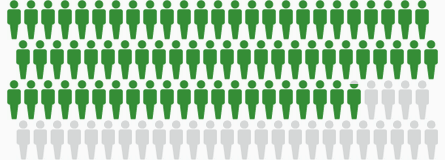
5-Year
Relative Survival
Based on data from SEER 21 (Excluding IL) 2016–2022. Gray figures represent those who have died from anal cancer. Green figures represent those who have survived 5 years or more.
Survival by Stage
Cancer stage at diagnosis, which refers to extent of a cancer in the body, determines treatment options and has a strong influence on the length of survival. In general, if the cancer is found only in the part of the body where it started it is localized (sometimes referred to as stage 1). If it has spread to a different part of the body, the stage is regional or distant. The earlier anal cancer is caught, the better chance a person has of surviving five years after being diagnosed. For anal cancer, 39.5% are diagnosed at the local stage. The 5-year relative survival for localized anal cancer is 85.0%.
| Stage | Percent of Cases | 5-Year Relative Survival |
|---|---|---|
| Localized Confined to Primary Site |
39% | 85.0% |
| Regional Spread to Regional Lymph Nodes |
38% | 70.1% |
| Distant Cancer Has Metastasized |
14% | 36.5% |
| Unknown Unstaged |
8% | 65.1% |
 Localized (39%)
 Regional (38%)
 Distant (14%)
 Unknown (8%)
SEER 21 (Excluding IL) 2016–2022, All Races, Both Sexes by SEER Combined Summary Stage
New Cases and Deaths
How Common Is This Cancer?
Compared to other cancers, anal cancer is rare.
| Rank | Common Types of Cancer | Estimated New Cases 2026 |
Estimated Deaths 2026 |
|---|---|---|---|
| 1. | Prostate Cancer | 333,830 | 36,320 |
| 2. | Breast Cancer (Female) | 321,910 | 42,140 |
| 3. | Lung and Bronchus Cancer | 229,410 | 124,990 |
| 4. | Colorectal Cancer | 158,850 | 55,230 |
| 5. | Melanoma of the Skin | 112,000 | 8,510 |
| 6. | Bladder Cancer | 84,530 | 17,870 |
| 7. | Kidney and Renal Pelvis Cancer | 80,450 | 15,160 |
| 8. | Non-Hodgkin Lymphoma | 79,320 | 19,970 |
| 9. | Uterine Cancer | 68,270 | 14,450 |
| 10. | Leukemia | 67,790 | 23,910 |
| - | - | - | |
| 24. | Anal Cancer | 11,270 | 1,700 |
Anal cancer represents 0.5% of all new cancer cases in the U.S.

0.5%
In 2026, it is estimated that there will be 11,270 new cases of anal cancer and an estimated 1,700 people will die of this disease.
Who Gets This Cancer?
Anal cancer is slightly more common in women than men. Infection with human papillomavirus (HPV) has been associated with this cancer. The rate of new cases of anal cancer was 2.0 per 100,000 men and women per year based on 2019–2023 cases, age-adjusted.
Males
| All Races | 1.6 |
|---|---|
| Hispanic | 1.1 |
| Non-Hispanic American Indian/Alaska Native | 2.0 |
| Non-Hispanic Asian/Pacific Islander | 0.5 |
| Non-Hispanic Black | 2.5 |
| Non-Hispanic White | 1.7 |
Females
| All Races | 2.4 |
|---|---|
| Hispanic | 1.7 |
| Non-Hispanic American Indian/Alaska Native | 2.9 |
| Non-Hispanic Asian/Pacific Islander | 0.5 |
| Non-Hispanic Black | 1.9 |
| Non-Hispanic White | 3.1 |


SEER 21 2019–2023, Age-Adjusted
| Age Range | Percent of New Cases |
|---|---|
| <20 | 0.0% |
| 20–34 | 1.0% |
| 35–44 | 4.8% |
| 45–54 | 13.1% |
| 55–64 | 29.3% |
| 65–74 | 30.0% |
| 75–84 | 15.9% |
| >84 | 5.9% |
Anal cancer is most frequently diagnosed among people aged 65–74.
Median Age
At Diagnosis
SEER 21 2019–2023, All Races, Both Sexes
Who Dies From This Cancer?
The death rate was 0.4 per 100,000 men and women per year based on 2020–2024 deaths, age-adjusted.
Males
| All Races | 0.3 |
|---|---|
| Hispanic | 0.2 |
| Non-Hispanic American Indian/Alaska Native | Not Shown, <16 cases |
| Non-Hispanic Asian/Pacific Islander | 0.1 |
| Non-Hispanic Black | 0.4 |
| Non-Hispanic White | 0.3 |
Females
| All Races | 0.4 |
|---|---|
| Hispanic | 0.2 |
| Non-Hispanic American Indian/Alaska Native | Not Shown, <16 cases |
| Non-Hispanic Asian/Pacific Islander | 0.1 |
| Non-Hispanic Black | 0.3 |
| Non-Hispanic White | 0.5 |
U.S. 2020–2024, Age-Adjusted
| Age Range | Percent of Deaths |
|---|---|
| <20 | 0.0% |
| 20–34 | 0.7% |
| 35–44 | 3.0% |
| 45–54 | 10.1% |
| 55–64 | 23.2% |
| 65–74 | 29.0% |
| 75–84 | 21.2% |
| >84 | 12.8% |
The percent of anal cancer deaths is highest among people aged 65–74.
Median Age
At Death
U.S. 2020–2024, All Races, Both Sexes
Trends in Rates
Changes Over Time
Keeping track of new cases, deaths, and survival over time (trends) can help scientists understand whether progress is being made and where additional research is needed to address challenges, such as improving screening or finding better treatments.
Using statistical models for analysis, age-adjusted rates for new anal cancer cases have not changed significantly over 2014–2023. Age-adjusted death rates have been rising on average 3.9% each year over 2015–2024. 5-year relative survival trends are shown below.
Interactive Statistics with SEER*Explorer
- Create custom graphs and tables
- Download data and images
- Share links to results
SEER*Explorer is an interactive website that provides easy access to a wide range of SEER cancer statistics. It provides detailed statistics for a cancer site by sex, race, calendar year, age, and for a selected number of cancer sites, by stage and histology.
Explore Additional Anal Cancer StatisticsMore About This Cancer
Cancer and the Anus
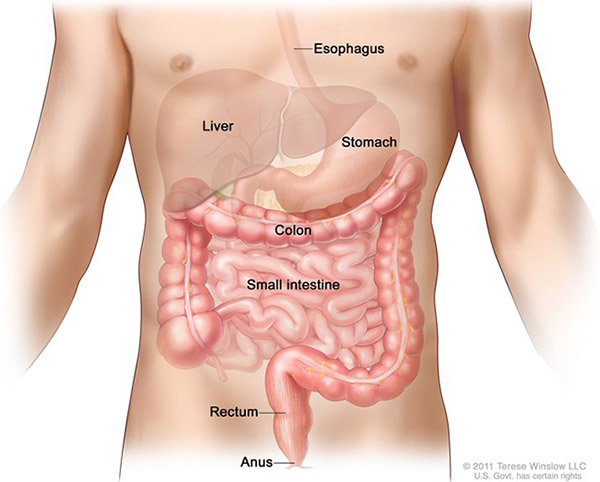
Figure: Gastrointestinal (digestive) system anatomy; shows esophagus, liver, stomach, colon, small intestine, rectum, and anus.
Anal cancer is a disease in which malignant (cancer) cells form in the tissues of the anus at the end of the large intestine, below the rectum. The anus is formed partly from the outer, skin layers of the body and partly from the intestine.
Additional Information
More Information
Here are some resources for learning more about anal cancer.
- About risk factors, symptoms, and diagnosis for anal cancer
- About treatment options for anal cancer
- About clinical trials
- About cancer prevention
- About HPV and cancer
References
All statistics in this report are based on statistics from SEER and the Centers for Disease Control and Prevention's National Center for Health Statistics. Most can be found within SEER*Explorer.
Suggested Citation
All material in this report is in the public domain and may be reproduced or copied without permission; citation as to source, however, is appreciated.
SEER Cancer Stat Facts: Anal Cancer. National Cancer Institute. Bethesda, MD, https://seer.cancer.gov/statfacts/html/anus.html
These stat facts focus on population statistics that are based on the U.S. population. Because these statistics are based on large groups of people, they cannot be used to predict exactly what will happen to an individual patient. To see tailored statistics, browse SEER*Explorer. To see statistics for a specific state, go to the State Cancer Profiles.
The statistics presented in these stat facts are based on the most recent data available, most of which can be found in SEER*Explorer. In some cases, different year spans may be used.
Estimates of new cases and deaths for 2026 are projections made by the American Cancer Society (ACS), based on earlier reported data.
Cancer is a complex topic. There is a wide range of information available. These stat facts do not address causes, symptoms, diagnosis, treatment, follow-up care, or decision making, although links are provided to information in many of these areas.
