 An official website of the United States government


* indicates required field
The SEER-Linked Virtual Tissue Repository (VTR) Program is currently not accepting new requests.
VTR Request Process and Documents
Investigators already approved to use the SEER-Linked VTR Program will be able to acquire de-identified, linked tissue, clinical data, pathology reports, and/or digital whole slide images (WSIs) and were required to complete the following submission and review process (Figure 1).
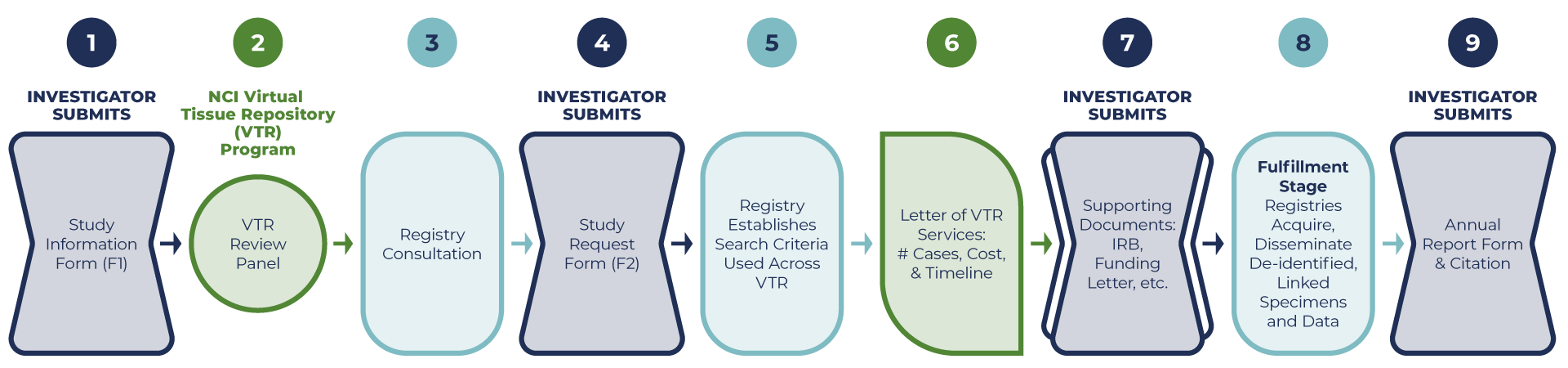
- Study Information Form (F1): The investigator created a log in to the VTR Request System and completed and submitted the Study Information Form (F1) in the VTR Request System.
- VTR Program Review Panel: met to decide if study was approved, conditionally approved pending further information, or declined. If the proposed study was approved, the Louisiana Tumor Registry was assigned as the VTR Contact Registry. NCI informed the investigator about the review outcome through the VTR Review Panel Outcome Letter sent via the VTR Request System.
- Initial Consultation about Request: The VTR Registry met with the investigator to advise them on study design and to answer questions. Meeting notes were sent by the registry as guidance for the investigator's next step.
- Study Request Form (F2): The investigator completed and submitted the Study Request Form (F2) in the VTR Request System.
- Case Counts, Budget, and Timeline Estimates: After receiving the Study Request Form (F2), the registry established the criteria to search their databases for eligible cancer cases. They will determine estimated case counts by demographic parameters, costs, and timeline for fulfillment of the request.
- Letter of VTR Services Available: The investigator received a letter from NCI VTR Program Staff with estimates of available cases, costs, and timeline for fulfillment.
- Project Documentation: When the investigator obtained funding for the project, they submitted the required regulatory documentation for the proposed project, uploaded this documentation to the VTR Request System. The NCI VTR Coordinator provided each investigator with the list of documentation needed, as it varied by project.
- Fulfillment Stage: The registry acquires, processes, and sends de-identified, linked data and/or tissue to the investigator.
- Annual Report: Investigators using the VTR Program to obtain tissue and/or data will complete an annual report form to include publications, presentations, and abstracts produced through the VTR Program-approved study.
What Should Investigators Do after Obtaining Funding?
After the investigator received the Letter of VTR Services Available and obtained funding for their study, they uploaded the regulatory documents to the VTR Request system. Investigators were asked to submit all or a subset of the following documents depending on study design and planned tissue-based studies.
- Updated contact information
- Curriculum Vitae for Each Investigator
- Institutional Review Board (IRB): The SEER-Linked VTR Program required investigators to submit their protocol to their IRB for determination of whether the study was exempt from review before receiving specimens and/or data. Because all tissue and data are deidentified before the investigator receives them, the study is not considered human subjects research. NIH investigators are required to submit an NIH Investigator Attestation Form.
- Copy of the Study Protocol
- Data Management and Sharing Plan: If the investigator's project is funded by the National Institutes of Health (NIH), the investigator was required to generate and submit a Data Management and Sharing Plan to comply with the NIH Data Management and Sharing Policy.
- Secured Funding: Investigators are responsible for securing funding and providing the NCI VTR Program Staff with documentation that funding was awarded for the project, the identity of the funder, and the start and end dates of the award.
- Institutional Certification: If the investigator requests tissue to be used for sequencing, then the investigator was required to have their institution sign an Institutional Certification and to comply with the NIH Data Management and Sharing Policy and the NIH Genomic Data Sharing Policy.
- Authentication and Authorization: The VTR Program uses the general SEER Data Request System for Research Plus data to authenticate and authorize each investigator who participates in the study. The email showing approval for SEER Research Plus Databases, serves as documentation.
- Material Transfer Agreement for the registry sending de-identified tissue.
After study fulfillment has begun, no changes that impact study design may be made to the request.
For additional information, please see the FAQs.
